
- But for transition elements, the valence electrons can be present in inner orbitals as well. This is due to the energy difference between the suborbitals. For example, the atomic number of Manganese (Mn) is 25. The electron configuration of cobalt is Ar 3d 5 4s 2.
- For example, although elemental sodium is a metal, solid sodium chloride is an insulator, because the valence electron of sodium is transferred to chlorine to form an ionic bond, and thus that electron cannot be moved easily.
- The number in the ones place of the group number is equal to the number of valence electrons in that atom (i.e. Group 1 elements have 1 valence electron, group 16 elements have 6 valence.
Key Differences – Valency vs Valence Electrons
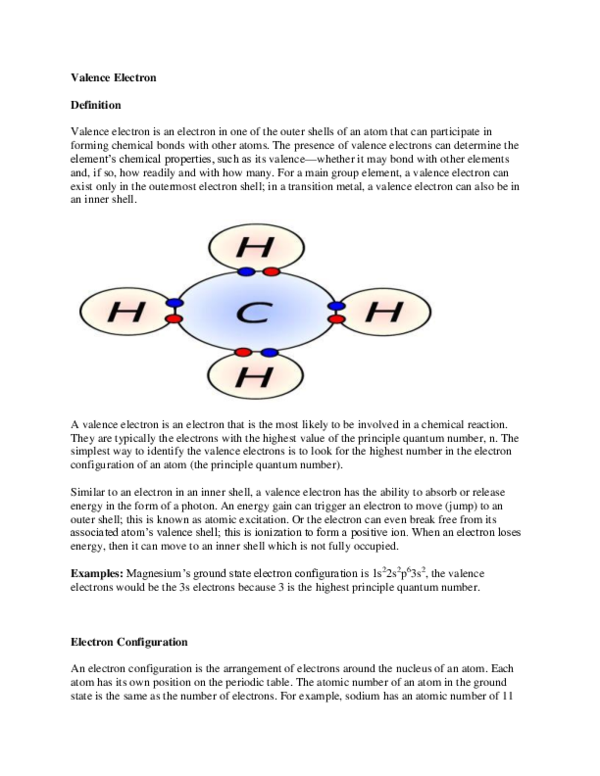
Valency electrons and valence electrons are inter-related terms, and the key difference between valency and valence electrons is best explained in their definitions; valence electronsare the electrons in the outermost shell of an element whereas valency electronsare the number of electrons that should be accepted or removed to attain the nearest noble gas configuration. It is the electrons in the outermost shell that usually contribute to form chemical bonds. In some atoms, the number of valence electrons is equal to the number of valency electrons.
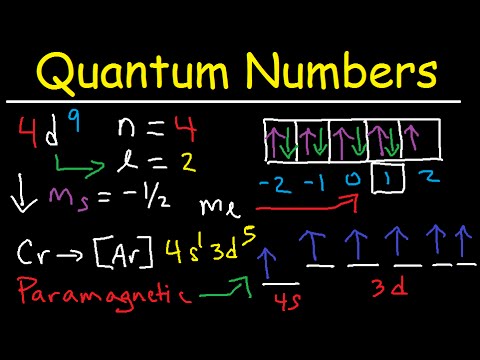
Valence electron definition is - a single electron or one of two or more electrons in the outer shell of an atom that is responsible for the chemical properties of the atom. Total Valence Electrons in water = 8; Example C. Determine the total number of valence electrons for MgBr 2. Magnesium, Group 2, has 2 electrons x 1 = 2; Bromine, Group 7, has 7 electrons x 2 = 14; Total # of Valence Electrons in MgBr 2 = 16; How to Draw a Lewis Dot Structure Step 1. Determine the total number of valence electrons to be.
What are Valence Electrons?
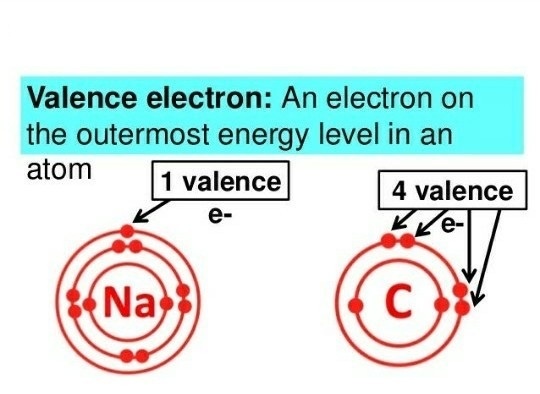
The number of electrons in the outermost shell of an atom is called “valence electrons”. Because of this reason, the outermost shell of an atom is called “valence shell”. Most of the time, these are the electrons, which take part in chemical bonding. When elements form cations, they remove electrons from the valence shell. The number of valence electrons in an element determines the group in the periodic table.
What are Valency Electrons?
The number of electrons required to gain or lose to fill the outermost shell of an atom is called “valency electrons”. For a particular atom, the number of valency electrons depends on the number of valence electron in the atom. For Sodium, valency is equal to 1, because it removes the last electron in the outermost shell to achieve octet structure of the nearest noble gas.
|
Valence Electrons Worksheet
What is the difference between Valency and Valence Electrons?
Definition of Valency and Valence Electrons
Valence Electrons: The electrons in the outermost shell of an atom are called “valence electrons”. For “s” and “p” group elements, the number of valence electrons is equal to their group number.
Example
Valency Electrons: The number of electrons that should be accepted or removed to attain the electron configuration of the nearest noble gas is called “valency electrons” or the “valence” of an atom.
In general, for metal elements (elements in group I, II and III), the number of valence electrons is equal to the number of valency electrons; they remove the electrons in the valence shell to achieve the octet structure.
But, non-metal elements accept electrons to achieve the electron configuration of the nearest noble gas. Therefore, the valency of non-metal elements is calculated by subtracting the total valence electrons from 8.
For Chlorine, Number of valency electrons = 8-7 =1

Characteristics of Valency and Valence Electrons
Valency and Valence Electrons of group VIII elements
Valence Electrons: Group VIII elements are the noble gases, and they are chemically stable. Their outer shell is complete, and it contains eight electrons in the outermost shell (except Helium –He); so that group VIII electrons have eight valence electrons.
Valency Electrons: Valency is a measure of the ability to form bonds with other elements or molecules. Noble gases do not accept or remove electrons to achieve the octet rule since they have already completed the last shell. Therefore, the valency of group VII elements equal to zero.
Valence Electrons Non Examples
Image Courtesy:
“Electron shell 010 Neon – no label” by commons:User:Pumbaa (original work by commons:User:Greg Robson) – http://commons.wikimedia.org/wiki/Category:Electron_shell_diagrams (corresponding labeled version).(CC BY-SA 2.0 uk) via CommonsValence Electrons Example Problems
Related posts: