
Writing Challenge for Kids is an app to express creativity, have fun with writing, spark inspiration and improve writing skills. WHO IS THIS APP FOR?. Kids between 7 and 14 years who want to write their own stories. Writers who want to write books for children. Persuasive Writing for K-5 Think persuasive writing is just for middle schoolers? This site includes valuable resources-printouts, lesson plans for different levels, links, and a student interactive-for teaching the art of persuasion to kids in kindergarten through fifth grade. Writing Challenge for Kids is an app to express creativity, have fun with writing, spark inspiration and improve writing skills. WHO IS THIS APP FOR?. Kids between 7 and 14 years who want to write their own stories. Writers who want to write books for children. Parents who want to make their kids. The challenge: draft an entire novel in just one month. For 30 wild, exciting, surprising days, you get to lock away your inner editor, let your imagination take over, and just create! Our Young Writers Program supports under-18 writers and K-12 educators as they participate in our flagship event each November, and take part in smaller writing.
Do you have trouble making time to write? Do you wish you had a community to help you work towards your writing goals, including staying on time and finishing your work?
Many writers sign up for writing challenges to help them solve these problems and write a large body of work in a short amount of time — or even to build their practice and discipline of writing consistently.
Besides completing work you can be proud of, participating in writing challenges is amazing because you get to work alongside a group of other writers who all share the same goal: finish that novel, finish that picture book, or write those short stories and poems. You support each other and hold each other accountable.
Writing challenges that will push you forward
If you’re up to the task, we’ve come up with some writing challenges to try, whether you’re a novelist, poet, picture-book writer or something in between.
Here are nine writing challenges to explore.
1. NaNoWriMo
Genre: Novel
This is the one you’ve probably heard of: NaNoWriMo, which stands for National Novel Writing Month, has been an annual November tradition since 1999. During NaNoWriMo, writers around the world challenge themselves to write a 50,000-word novel in 30 days.
What’s special about 50,000 words? As NaNoWriMo’s organizers explain: “Our experiences since 1999 show that 50,000 is a difficult but doable goal, even for people with full-time jobs and children. The length makes it a short novel (about the length of The Great Gatsby).”
You’ll need to write about 1,667 words every day to hit the 50,000-word count, but you won’t be alone; the online NaNoWriMo community helps you track and share your progress while awarding badges for hard work and providing inspiration through interviews with well-known writers and other motivational tools.
Several writers have published novels they initially drafted during NaNoWriMo, including Sara Gruen’s Water for Elephants and Erin Morgenstern’s The Night Circus.
If you’re looking for a similar option, check out Camp NaNoWriMo to experience a writing adventure that offers more flexibility. Hosted annually in April and July, you can set your own writing goal and work on any writing project, novel or not.
2. NaPoWriMo
Genre: Poetry
If NaNoWriMo is National Novel Writing Month, I bet you can guess what NaPoWriMo stands for.
National Poetry Writing Month takes place every April, and challenges writers to pen 30 poems in 30 days. You’ll have access to daily prompts to help your creative juices flow, but you’re welcome to ignore ‘em, too.
Independently organized, NaPoWriMo is much smaller than NaNoWriMo, so don’t expect your local library to organize NaPoWriMo nights — unless, of course, you want to organize one on your own!
Some writers share their NaPoWriMo poems on their websites or via social media, and help spread their love of poetry while showing off their ability to complete the challenge.
3. StoryADay
Genre: Short stories
So we’ve got novel-writing in November and poetry in April. What about short stories? That’s in May and/or September (or whenever you want!), and it’s called StoryADay.
StoryADay is a little different from NaNoWriMo and NaPoWriMo in that it focuses on completing a short story every day, rather than ending the month with a certain number of stories or a specific word count.But there are rules:
- If you miss a day or don’t finish a story, move on. You still have every other day of the month (of your life) which is a new day, on which a new story can be told.
- Don’t go back and try to finish yesterday’s story. Leave it. Wash your hands of it. Move on.
- As long as you keep writing, you’re not failing.
Starting — and finishing — a new short story everyday sounds like a much harder challenge than writing a 50,000-word novel in a month; but “sometimes you need a big, hairy audacious goal, to scare your Inner Critic into letting you write.”
4. 12 x 12
Genre: Picture books
If you write picture books, you might want to consider signing up for the 12 x 12 writing challenge created by Julie Hedlund, author of My Love For You Is the Sun.The challenge: write 12 picture books in 12 months!
Unlike other writing challenges, 12 x 12 comes with a membership fee. The basic package costs $177 and grants you access to writers’ forums, the member Facebook group, feedback from traditionally-published authors and much more. If you choose the higher level membership — which are only available to people who have already participated in at least one year of 12 x 12 — you get to submit your work directly to participating agents.
Do 12 x 12 writers get published? Absolutely. Check out their list of published writers to get inspired.
While 12 x 12 is open 24 hours a day, 365 days a year, registration is closed for 2020 and will resume in 2021.
5. ChaBooCha
Genre: Young adult
Young adult writers can use NaNoWriMo to write their books, but there’s also a writing challenge just for them: ChaBooCha, or the Chapter Book Challenge.
Hosted by writer Rebecca Fyfe, ChaBooCha runs every March and challenges you to “Write one completed first draft of an early reader, chapter book, middle-grade book or YA novel,” from the 1st to the 31st of March.
Your results could be anywhere between 1,000 and 80,000 words, depending on whether you’re putting together an early reader or writing the next book in your YA series. Either way, ChaBooCha is there to help you get the job done, with motivational blog posts from authors, agents and publishers — as well as prizes.
ChaBooCha is open to writers under 17, too!
6. YeahWrite
Genre: Nonfiction, fiction, poetry, microstories
After reading about all of these programs that challenge you to write 50,000 words or 31 new short stories in a month, are you ready for a writing challenge that’s designed to fit your schedule?
It’s time to check out YeahWrite, a writing site that issues one writing challenge each week for each of three genres: nonfiction, fiction/poetry and microstories.
This writing challenge differs from the others on this list because every week, community members vote on a challenge winner. You’re not only participating in a writing challenge, you’re also getting reviewed by other writers — and you might write well enough to win the week!
YeahWrite is all about community, so it’s free to join. But a paid membership helps keep the site running and gets you access to editorial consultations with YeahWrite editors. There are two membership packages that cost either $25 or $50 per year; each gives you access to editorial evaluations, discounts and more, so check them out!
7. NaNonFiWriMo
Genre: Nonfiction
The Write Nonfiction in November Challenge (WNFIN) was created by Nina Amir, a coach who inspires writers and bloggers to create published products and careers as authors. Unlike NaNoWriMo, this informal challenge comes with only one rule: You have to commit to starting and finishing a work of nonfiction in a month.
“No one counts how many words you write during the month or even checks what you write. You can write any type of nonfiction, such as a magazine article, blog posts, a white paper, or a book.” And your WNFIN project can even be as short or as long as you like.
To help you along with the challenge, you can join the WNFIN Facebook page, and the Remote Writing Room provides you with a virtual group of writers you can chat and write twice per week. Plus, check out Nina’s blog for more inspiration and tips to improve your nonfiction writing process.
Stay tuned for 2020 WNFIN details!
8. 365 Writing Challenge
Genre: All genres are welcome
The benefits of discipline and daily practice can’t be underestimated, and that’s what the 365 Writing Challenge wants to help you develop. Created by Jessica White and her group the 10 Minute Novelists, this challenge has helped hundreds of writers over the past five years write more than 100 million words. To be able to participate, you must be a member of the 10 Minute Novelists Facebook Group.
All you have to do is set aside 10 minutes every day to write, which is about 100 words a day. You can also use that time to reflect on the writing process, set weekly writing goals, or even flesh out a setting or a character.
Upon choosing a membership tier, you’ll be provided a Google Sheet to help you keep track of your daily word count, and at the beginning of each month, Jessica awards badges for the prior month’s achievements.
It doesn’t matter if you spend 10 minutes or 4 hours a day writing — “the key is consistency so you can grow as a writer and finish your projects.” Look out for 2021 registration details later this year.
9. The Writer’s Games
Genre: Short stories and poetry

The Writer’s Games is a free competition designed to help each individual writer improve his or her craft at an accelerated rate. This free six-week, multi-challenge writing competition comes with feedback for every entry, opportunities for publication throughout the competition, and the ability to use judge feedback on previous entries to improve them.
Here’s how it works: Each week starting in May and September, a surprise Event is announced and writers have 72 hours to create a short story or poem that fits the Event requirements. Every entry received before the deadline is judged and critiqued by a team and winners are published in a charitable anthology.
And don’t worry about being eliminated — every registered writer is encouraged to try each of the six Events, even if one of their previous stories was disqualified, which is rare.
Registration opens April 1 and August 1 for two separate portions, and keep in mind that space is limited.
So, are you ready to take on one of these writing challenges?
Online Writing For Kids
This is an updated version of a story that was previously published. We update our posts as often as possible to ensure they’re useful for our readers.
Photo via G-Stock Studio / Shutterstock
Do your students grumble when it’s time to practice writing? Is getting them to write an essay about as much fun as getting grapefruit juice in your eye? Maybe it’s time to try some fun writing activities instead. Here are ten of our family’s favorite creative writing activities for kids.
Breaking Kids out of a Writing Rut
We’ve been through so many stages of learning to write in our homeschool: reluctant writers, frustrated writers, bored writers, curious writers, obsessive writers (my favorite!).
Over the years, we’ve tried countless writing programs and curricula in a constant effort to keep writing fun and interesting. While we’ve had success stories with a few programs, I find one of the best ways to keep kids engaged with writing is to integrate fun activities alongside our regular curriculum.
Here are ten of my favorite ways to make writing fun for kids.
10 Fun Writing Activities for Kids
1. Write a comic book/graphic novel
Using a template, students create their own comic strip or graphic novel complete with speech bubbles and annotations.
First, you’ll need a comic strip template. You can draw your own or allow kids to do so if they choose. Or, download the companion files at the end of this post to grab some pre-formatted templates.

The amount of guidance each student needs will vary depending on their age and ability. By design, comics and graphic novels are straight to the point. They don’t have room for any superfluous content.
Therefore, it’s a good idea to take time beforehand and plan what’s going to happen in the short story, either using a story planner or just jotting down a quick storyboard sketch. They’ll want to have a sense of what’s going to go in each square before they start drawing the pictures in earnest.
Have them draw the pictures first and then add speech and thought bubbles and annotations. If possible, display the finished works so everyone can enjoy them.
Kids are naturally drawn to the comic book or graphic novel format. It’s fun it’s engaging, it moves quickly, and there’s lots of pictures.
But the space constraints make it necessary for them to think through their story before they start writing and this is such an important skill to develop. Usually, when we’re writing an essay or a short story, we just write whatever comes into our minds without editing as we go. Often, we write way more than we need to and when we go back to read it later, we find we haven’t even made our point.
Learning how to outline and determine in advance the best way to get a point across is an important skill and creating comic strips is a great way to learn it.
This writing activity can be adapted for any age range, kindergarten to grade 12. Younger kids may need assistance with printing small letters.
2. Write a Story Together
What it is:
Students work in pairs or groups or with a parent or writing coach to write a short story together.
There are many ways that two or more people can work together to write a short story. The method you choose will depend on who you’re working with, how much time you have, and what your goals are for the activity. Here are a couple of options:
- Writing together: Kids work in pairs or groups (with or without a parent, teacher, or writing coach) to collaborate on each part of the story. Everybody pitches ideas and the group comes to a consensus about them. Kids can take turns acting as the scribe for the group (an adult can do the writing for younger children).
Agree in advance about how you’ll know when the project is finished. Are you aiming for a certain number of words or pages? Or do you just want to see a story with a beginning, middle, and end? Perhaps you want them to practice a specific concept, like seeing how many similes and metaphors they can use.
Determining and articulating the goal ahead of time ensures everyone knows what they’re working towards.
- Writing consecutively. Students take turns writing sections of the story. For example, they might alternate paragraphs or pages, depending on how long it is.
You can either have them agree in advance about the topic and plot points or you could add a twist by not letting them talk about it in advance and having them improvise.
Another variation is to have a group of students working together and have each of them write a sentence or a paragraph of a story and then pass their story on to the person beside them. That person then continues on with that story while the one who started it is continuing on with another person’s story themselves. Continue passing them around in a circle until everyone has added to each story and then can share them with each other.
- Write concurrently: Kids decide on a plot for a story and then divide and conquer. For example, they might come up with a story that has multiple perspectives and have each person can write scenes from a different perspective. After, they can integrate them into a cohesive, well-rounded story.
In my experience, kids love creating stories much more than they actually love writing them, especially when they’re younger. The physical act of getting their thoughts onto paper is time-consuming and because their hands can’t move as fast as their thoughts, kids often get discouraged.
Collaborating with a sibling, a friend, classmates, or adults gives them the immediate reward of progressing in a story without necessarily having to bear the burden of doing all the work themselves.
This writing activity can be adapted for any age range, kindergarten to grade 12. Lower elementary students should work with a parent, teacher, or writing coach who can guide the collaboration and record the story for them.
3. Retelling a Favorite Story
What it is
Reading or listening to a favorite story and retelling it or rewriting it in their own words.
Ask a student to choose one of their favorite books. For younger kids, this would ideally be a board book or a picture book, while older students might like a chapter book or novel. If choosing a novel, make sure it’s one they’re very familiar with so they don’t need to re-read the whole thing.
If it’s a shorter book, read it together. Then, ask the student to either narrate or write down the major parts of the story in their own words.
Another variation: if you have more time, get a big piece of paper or poster board and ask the kids to draw a map of the story. Then, have them draw and cut out pictures of the story’s characters and move them around the map as they tell the story.
Writers learn to write by imitating other writers. Reading a favorite story with the goal of committing its key points to memory is an important step toward becoming a better storyteller. By telling and retelling popular tales, students learn to intuit the elements of a great story.
This writing activity can be adapted for any age range, kindergarten to grade 12. Students who are not yet reading or writing will need someone to read the story and transcribe their words.
4. The End. Or, The New Beginning.
What it is
Students choose a book they love and give it a new ending or a sequel.
Have students choose a favorite book and decide whether they’re going to rewrite the ending or write a sequel.
Ask them questions to help them give structure to their writing. Here are some examples:
If re-writing the ending:
- What did you like about the current ending?
- What didn’t you like?
- What questions did you have at the end of the book?
- What event in the story, if changed, would have resulted in a completely different outcome?
- Did the main character get what they wanted or no? What would have happened if they didn’t (or did)?
If writing a sequel:
- Which character(s) in this story did you wish had bigger roles? What else might you have liked to know about their sides of the story?
- What do you think happened after the last chapter of the story?
- What other threats or enemies might still be waiting for the main character?
- Think about the life of the book’s characters at the end of the story. What new character or event might completely topple the balance they’ve found?
Asking students to write a new ending or sequel takes away the pressure of having to come up with an idea from scratch, while still giving them a valuable opportunity to improve their writing skills.
Also, it helps them hone in on the skill of writing endings, which are often the hardest part of the story to write.
This writing activity can be adapted for grades 4 to 12.
5. Dictating a Story
What it is
Dictating a story using voice typing and then editing it
Using a Google Doc, click on the Tools menu and select Voice typing (or press CTRL+Shift+S). Click on the microphone icon and have the student start dictating.
When they’re done, click the microphone again. They can even make changes or fix punctuation as they go without disabling the microphone.
Again, people think much faster than they write or even type.
For emerging writers especially, printing each letter takes so long that by the time they’ve gotten a full sentence down, they may have lost their steam. Being able to dictate the story at the speed they think and talk is highly motivating and puts the focus on idea generation and plot progression, not on the physical act of writing.
Also, this activity gives kids a wonderful opportunity to practice their editing skills.
This writing activity can be adapted for any age range, kindergarten to grade 12. Younger kids will need help with editing.
6. Create Mad Libs
What it is
Students design Mad Libs for you or for each other
If your students have never played Mad Libs, you will first need to explain the game to them and maybe have them do a practice round to get used to the concept. Here’s a sample Mad Lib you can use. It’s also included in the companion files download at the bottom of this post.
Then have them prepare the story. They can either create it from scratch or use an existing text. For example, they might copy out the first paragraph or two of a book. Have them write it on lined paper, double spaced.
Next, they can choose some words to remove from the story. Once they’ve erased the words they want to remove, they should draw a line for the blank word and write a hint under the line to indicate what kind of word is needed.
It’s helpful if they have an understanding of nouns, verbs, adjectives, and adverbs. If they don’t, this is a great time to introduce these concepts. They might also use qualifiers such as ‘something you wear,’ or ‘a job people do.’
Here’s how a finished Mad Lib might look:
When they’re done preparing the story, someone else (a friend, parent, teacher, etc.) gives them the words needed to fill in the blanks. As the respondent gives their answers, the student writes them in the blanks. When all the blanks are filled, the student reads the finished work aloud.
I’ve yet to meet a kid who doesn’t love Mad Libs. They’re so much fun! Kids get a kick out of making up a really silly story while subtly learning the differences between the various types of words.
This writing activity can be adapted for grades 4-12.
7. Custom Printing Pages
What it is
Creating custom writing worksheets for younger kids who are learning to print
I know….I promised fun writing activities. And usually, worksheets are not fun. But I think these ones are different.
My five-year-old doesn’t enjoy practicing her letters and she puts up a huge fight when I ask her to copy things out. Fair enough—learning a challenging new skill is frustrating, even for adults.
But then I discovered this resource. Among the many cool custom worksheets this site can generate, I discovered the customizable printing pages. You can choose the line size, the style of writing, whether you want students to trace or copy, and—most importantly—the text they’ll be copying.
For my daughter, I wrote out a really fun story based on her life but with lots of embellishments and twists. She is the star of the story and she wants to know what happens to her. It took me about five to ten minutes to come up with enough content to fill 27 pages of writing practice sheets (about a month’s worth). I give her one page per day to copy. I haven’t heard a single complaint.
Give it a try. Pick the settings that suit your student(s) best and write a few paragraphs that they won’t be able to stop reading. Then have them trace or copy a small amount each day.
Kids tend to engage more with the learning process if they think it’s a game rather than a lesson. Who wouldn’t want to read a story starring themselves?
Creative Writing Challenges
(I still have a customized Christmas book my dad ordered for me when I was three!) It incentivizes them to practice their printing or cursive handwriting by giving them a delightful reward.
This writing activity can be adapted for kindergarten to grade 6.
8. Photographic Writing Prompts
What it is
Writing a story based on an image.
A picture is worth a thousand words, right? And nobody wants to read a thousand-word writing prompt, so why not try photographic writing prompts? This fun writing activity is simple and can be pulled off with almost no prep time.
First, choose an image you want to display. Then, set a timer. Have everyone (even you) write a story inspired by the picture for fifteen minutes. No planning for this one; this time we’re writing by the seat of our pants. When the timer ends, stop writing. Give students an opportunity to share their stories if they like.
The companion files document at the bottom of this post includes ten fun images you can use as writing prompts.
Images are often more inspiring than words and leave more room for interpretation. This, combined with the focus on writing, rather than planning, encourages kids to simply write, rather than fretting about ideas or structure.
Because of the timed and independent nature of this writing activity, it’s best for kids in grades 5 to 12.
9. Convince Me
What it is
Using a creative piece of writing to influence someone’s opinion.
In this writing activity, students create a persuasive piece of writing aimed at convincing you that their favorite thing is the best, i.e. Why Wings of Fire is the Best Dragon Series You’ll Ever Read, or Why Strawberries are the One Fruit We Could All Live On.
Offer suggestions on what format they might choose, but leave the decision up to them. They might write a short essay, a poem, a song, or a rap. Maybe they’ll even decide to create a brochure. Put as few limitations on this final product as possible to encourage maximum creativity.
When they’re done, have them read they’ve written to try to persuade an audience.
Kids can be highly persuasive, but adults often shut them down when they’re trying to make an argument. For example, every time my daughter says she has a compelling list of reasons why we should let her get a hedgehog, I typically say no immediately without giving her a chance to share her list.
Giving them the opportunity to persuade you about something that matters to them, and to do it in a format they feel comfortable with is an opportunity they won’t want to miss. This fun writing activity also helps them develop their persuasive writing skills. In your feedback, you might offer points on how they can enhance their argument even more.
This writing activity can be adapted for grades 2 to 12.
10. A is for Author
What it is:
Using photos or drawings, along with original writing, to create a new alphabet book.
If possible, go on a nature walk or at least go to a yard or a field. For this writing activity, it’s important that students have many things to observe. Bring notepads and pens or pencils.
Have them try to find one thing for each letter of the alphabet. Allow them to be creative here: ‘eXcess dandelions’ might be a perfect choice to represent X. Have them use their notepads to keep a list of what they’ve found.
Then, set them to work. Let them choose how they will lay their book out. They might use a full page for each letter, a half-page, or a quarter-page. (I’ve included templates for half- and quarter-page layouts) below.
For each letter, they should include a drawing or photograph and a small amount of writing. The writing can be as simple as ‘C is for Crane,’ or it could be more creative, such as a short poem or a paragraph about that thing. Determine how much leeway you’ll give them with the writing component based on their ages and ability.
Have them add a cover page and then assemble their book with staples or by punching holes along the side and tying ribbon or string through each hole.
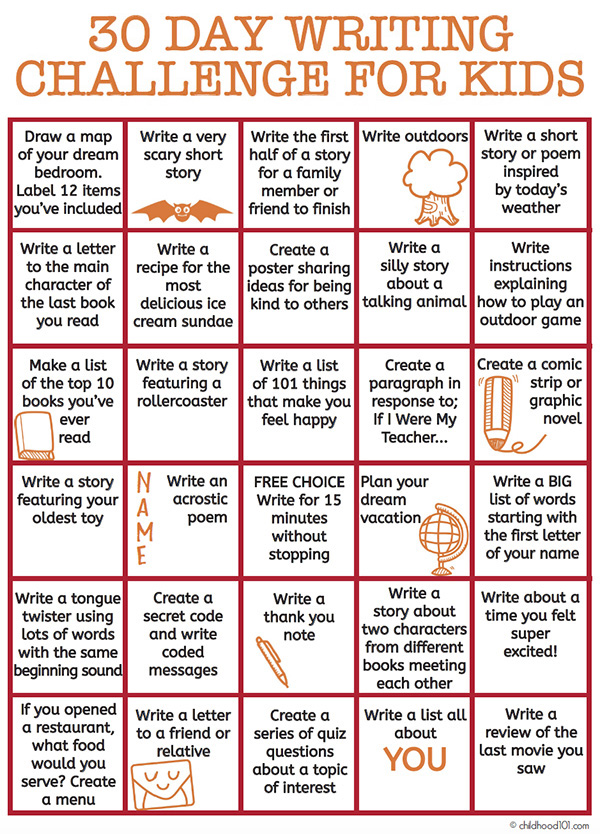
This fun writing activity works well for both reluctant and eager writers. It takes the focus of writing by including other activities such as walking outside and drawing, while also giving ample opportunity to practice printing (for younger kids) and composition (for older kids).
Eager writers will enjoy the opportunity to add prose or facts to their pages and appreciate the challenge of coming up with something creative for each page.
For this activity, kids may work independently or together, depending on time and preferences. Our family worked together on a single book and it turned out great.
This writing activity can be adapted for any age range, kindergarten to grade 12.
Get the Companion Files
Use the form below to download everything you need to start teaching with these fun creative writing activities for kids today!